Executive Summary
The autumn of 2026 marks a decisive inflection in quantum information science: the transition from heuristic noisy intermediate-scale quantum (NISQ) demonstrations to verified fault-tolerant quantum computing (FTQC) primitives. In the 30–90 days leading up to October 24, 2026, experimental teams across superconducting circuits, trapped ions, bosonic cavities, neutral atoms, and silicon spin systems reported major peer-reviewed milestones and commercial benchmarks. This review provides an independent, scientifically grounded analysis of seven defining developments, clarifying what was physically demonstrated, what remains unsolved, and why scaling demands sophisticated design automation.
Key Takeaways
- Teleportation Phase Transitions (Oct 22, 2026): Zhejiang University, HKUST, and Hefei Lab demonstrated surface-code state teleportation up to distance on a 125-qubit superconducting processor, showing that non-Clifford magic resources restore duality symmetry and lower entanglement thresholds.
- Beating Break-Even via Autonomous QEC (Oct 23, 2026): USTC demonstrated autonomous error correction on a single trapped ion, extending logical qubit lifetime to ~11.6 ms without measurement feedback loops by dissipating entropy via sympathetic cooling.
- Trapped-Ion Logical Memory (Oct 19, 2026): Quantinuum reported 99.9995% logical memory fidelity (~5 errors per 1,000,000 operations) on its Helios processor under color codes—a milestone in state retention, though distinct from universal fault-tolerant computation.
- Bosonic Error Semi-Transparency (Oct 8, 2026): Research published in Nature Communications demonstrated dynamic encoding subspaces reducing photon-loss-conditioned gate infidelity by 5-fold in bosonic cavity logical qubits.
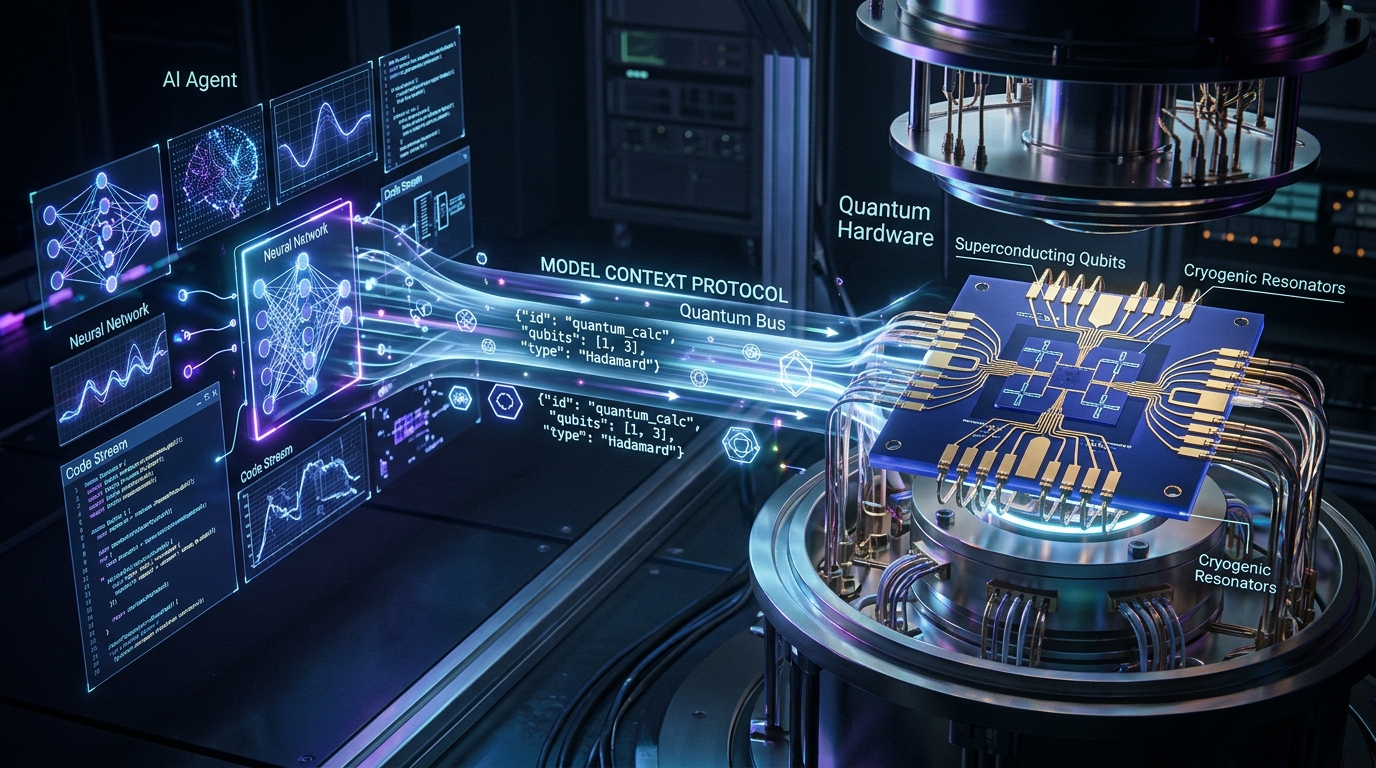
- Directed Execution & Qiskit 2.6: IBM transitioned from server-side error mitigation to client-directed execution (
Executorprimitive) on 100+ qubit QPUs, alongside high-performance C/Rust compiler extensions for quantum-centric supercomputing (QCSC). - Classical Decoding Throughput (Sept 22, 2026): IonQ demonstrated a dual-decoder running on a consumer laptop CPU (Apple M4 Max) decoding simulated circuits of up to 408 logical qubits with only 0.02%–0.3% stretch time.
- Physical Qubit Counts Do Not Equal Power: Increasing physical qubit numbers compounds crosstalk, dielectric loss, and wiring bottlenecks unless paired with high two-qubit gate fidelities, low-latency decoding, and robust error correction.
1. Foundations: Navigating the Fault-Tolerant Landscape
For nearly a decade, quantum computing was framed within the "NISQ" (Noisy Intermediate-Scale Quantum) paradigm, coined by John Preskill in 2018 [1]. In NISQ systems, unencoded physical qubits executed shallow circuits while researchers relied on post-processing heuristics to mitigate noise.
As of late 2026, the field is transitioning toward fault-tolerant quantum computing (FTQC). Evaluating contemporary research claims requires clear conceptual boundaries:
A. Physical vs. Logical Qubits
A physical qubit is an unencoded, raw two-level quantum device—such as the non-linear energy levels of a superconducting transmon or the hyperfine states of a trapped ion. Physical qubits suffer from environmental decoherence (relaxation time and dephasing time ) with error rates typically ranging between and [2].
A logical qubit is a protected quantum state distributed across an ensemble of physical qubits governed by an error-correcting code (such as a surface code, color code, or bivariate bicycle code). When physical error rates fall below the fault-tolerance threshold (), increasing the code distance () exponentially suppresses the logical error rate:
B. Error Mitigation vs. Quantum Error Correction
Error mitigation (e.g., Zero-Noise Extrapolation, Probabilistic Error Cancellation, and Clifford Data Regression) is a post-processing technique that reconstructs noise-free expectation values by running multiple noisy circuit variants. While effective for shallow circuits, mitigation incurs an exponential sampling overhead with circuit depth, making it fundamentally incapable of running deep algorithms like Shor's factoring or large-scale quantum chemistry [3].
Quantum Error Correction (QEC) actively diagnoses and corrects physical errors in real time during circuit execution without collapsing the superposed quantum state. It relies on non-destructive stabilizer measurements and low-latency classical decoders running within the qubit coherence window.
C. Memory Lifetime vs. Gate Fidelity
A logical qubit can demonstrate exceptional memory lifetime (idling or retaining an unperturbed state while syndrome cycles correct passive drift). However, executing universal logical gates—particularly non-Clifford operations like the -gate ( phase shift) or entangling CNOT gates between separate code blocks—introduces complex error propagation that demands magic state distillation or transversal gate protocols. High memory fidelity does not imply universal fault tolerance.
D. Benchmark Performance vs. Practical Quantum Advantage
Claims of "quantum advantage" are strictly workload- and benchmark-specific. Early demonstrations relied on Random Circuit Sampling (RCS)—sampling output distributions of random circuits. While classically intractable, RCS possesses no industrial utility and cannot be verified once system size exceeds ~70 qubits.
Practical quantum advantage requires solving a verifiable scientific or commercial problem faster, cheaper, or more accurately than the strongest classical algorithms (including tensor network states, matrix product states, and high-performance classical supercomputers). Any advantage claim that does not benchmark against state-of-the-art classical methods is scientifically incomplete [4].
E. Experimental Demonstrations vs. Commercial Readiness
A university breakthrough published in Nature Physics demonstrating a distance-7 logical state teleportation is a triumph of physics. However, commercial readiness requires automated wafer yields, low-crosstalk multi-layer interconnects, scalable cryogenic dilution refrigeration with microwatt dissipation budgets, and robust software compilers.
2. Seven Landmark Quantum Breakthroughs of Late 2026
Between September and late October 2026, seven significant experimental and architectural milestones advanced the state of the art. Below, each development is analyzed with explicit publication dates, institutional affiliations, demonstrated metrics, and candid scientific caveats:
1. Teleportation Transition of Surface Codes on a 125-Qubit Superconducting Processor
Peer-Reviewed JournalDate: October 22, 2026 · Source: Nature Physics (DOI: 10.1038/s41567-026-03484-0, arXiv:2602.21293) · Authors: Y. Zou, H.-K. Xia, A. Zhang, X. Zhu, F. Jin, H. Wang, et al. (Zhejiang University, HKUST Guangzhou, Hefei National Laboratory) [5].
What Was Demonstrated: The research team experimentally prepared rotated surface codes up to code distance using a linear-depth unitary circuit on a planar 125-qubit superconducting quantum processor. By uniformly tuning local entangling gates, the authors mapped the teleportation phase diagram for topological surface codes, observing a sharp phase transition separating successful teleportation from teleportation failure.
Crucially, the team demonstrated that the entangling threshold can be substantially enhanced by applying coherent single-qubit rotations that inject magic resources beyond the Clifford group. This process restores the underlying duality symmetry of the topological phase, establishing a physical design rule for minimizing the entanglement resources necessary to transfer logical information across a chip.
Significance & Limitations: This result bridges condensed-matter topological phase theory with fault-tolerant circuit engineering. However, the experiment demonstrates state teleportation and phase transitions; it does not constitute repeated, active syndrome-extraction error correction cycles during continuous computation.
2. Beating the Break-Even Point with Autonomous Quantum Error Correction
Peer-Reviewed JournalDate: October 23, 2026 · Source: Nature Physics (arXiv:2504.16746) · Authors: Y. Li, Y. Lin, J. Du, et al. (University of Science and Technology of China / Hefei National Laboratory) [6].
What Was Demonstrated: Conventional QEC relies on active syndrome measurements, FPGA decoding logic, and fast classical feedback to apply corrective pulses—processes that themselves introduce noise. In this milestone, researchers demonstrated Autonomous Quantum Error Correction (AQEC) on a trapped-ion platform, bypassing measurement and feedback loops entirely.
By encoding a logical qubit into multiple internal spin states of a single trapped ion and applying engineered spin-motion couplings, error-induced entropy was continuously transferred into motional phonon modes. An adjacent ancilla ion sympathetic cooling mechanism continuously dissipated this entropy into the environment. Under injected low-frequency noise, the logical qubit extended its coherence lifetime to approximately 11.6 milliseconds, definitively surpassing the break-even lifetime of its uncorrected physical components.
Significance & Limitations: Proves that continuous-wave dissipation can autonomously protect quantum memory without latency bottlenecks. However, this demonstration is confined to an isolated single-ion logical memory under low-frequency dephasing; extending AQEC to multi-qubit entangling gates across ion shuttling networks remains a formidable experimental challenge.
3. Quantinuum Closes In on One Million Error-Free Operations
Company Announcement / BenchmarkDate: October 19, 2026 · Source: Quantinuum Technical Announcement · System: Helios Commercial QCCD Trapped-Ion Processor [7].
What Was Demonstrated: Quantinuum reported a landmark logical memory fidelity of 99.9995% on its commercial Helios processor, corresponding to approximately five uncorrectable errors per one million operations. Utilizing color code architectures, the company reported that logical memory errors decreased by an average factor of ~12 for each code distance increment.
Critical Scientific Context: This is a self-reported commercial benchmark tracking Quantinuum's roadmap toward its planned 2029 "Apollo" universal system. Crucially, the 99.9995% metric reflects logical memory retention during repeated syndrome extraction cycles. It does not demonstrate universal logical computation with non-Clifford -gates or multi-qubit logical algorithms. Independent peer review and verification on arbitrary algorithmic circuits will be essential to establish full computational fault tolerance.
4. Error-Semitransparent Universal Control of a Bosonic Logical Qubit
Peer-Reviewed JournalDate: October 8, 2026 · Source: Nature Communications (arXiv:2603.15356) · Authors: S. Roy, O. C. Wetherbee, and V. Fatemi [8].
What Was Demonstrated: Bosonic quantum error correction utilizes the infinite-dimensional Hilbert space of a microwave cavity oscillator to build hardware-efficient logical qubits. However, executing universal logical gates without exposing the cavity to dominant photon-loss errors has remained an elusive target.
Roy, Wetherbee, and Fatemi introduced dynamic encoding subspaces driven by simple linear microwave tones to achieve Error Semi-Transparent (EsT) universal control—specifically the gate set. Conditioning gate fidelity on single-photon loss, the authors demonstrated a five-fold reduction in gate infidelity and constructed composite non-Clifford operations using sequences of eight EsT gates.
Significance & Limitations: Validates a practical pathway for protecting bosonic qubits during active gate execution rather than just during passive storage. However, full fault tolerance still requires active monitoring of transmon ancilla errors used to drive the cavity.
5. IBM Quantum: The Error-Correction Continuum, Directed Execution & Qiskit 2.6
Corporate Technical Report & SDK ReleaseDate: September–October 2026 · Source: IBM Quantum Research Blog & Qiskit Releases · Organization: IBM Quantum [9].
What Was Demonstrated: IBM reframed the transition from near-term computation to fault tolerance as an "error-correction continuum"—combining postselected syndrome detection and hierarchical codes to slash sampling overhead by ~10× on 100+ qubit processors (e.g., Heron and Nighthawk).
To support this, IBM launched the Directed Execution runtime model powered by the Executor primitive. This shifts error mitigation routines (Pauli twirling, noise learning, and probabilistic error cancellation with shaded lightcone pruning) from a server-side black box into client-controlled, transparent execution. Concurrently, Qiskit v2.6 expanded its core Rust compiler with a high-performance C API, enabling direct integration with C++, Fortran, and Julia in high-performance computing (HPC) workflows.
Significance & Limitations: Represents vital systems software infrastructure bridging experimental physics to Quantum-Centric Supercomputing (QCSC). It is important to distinguish these architectural runtime updates from novel physical hardware discoveries.
6. Real-Time Classical QEC Decoding on a Consumer CPU (IonQ)
Preprint / Company Technical ReportDate: September 22, 2026 · Source: arXiv Technical Report · Authors: M. Ye, A. Maksymov, and N. Delfosse (IonQ) [10].
What Was Demonstrated: A persistent concern in fault-tolerant quantum computing is the "decoding backlog problem": classical syndrome decoders becoming overwhelmed by high-rate syndrome data, forcing the quantum processor to pause. IonQ demonstrated a dual-decoder architecture running on a single standard laptop CPU (Apple M4 Max).
Evaluating the decoder against simulated circuits scaling up to 408 logical qubits (88 memory blocks and magic state factories) executing over 31.5 million quantum operations (>1M -gates), the software introduced only 0.02% to 0.3% stretch time (processing latency).
Significance & Limitations: Proves that classical decoding overhead can be managed without expensive custom ASIC or FPGA clusters. Crucially, this benchmark was executed on classical software against simulated syndrome streams; it does not demonstrate 408 physical logical qubits executing on physical quantum hardware.
7. High-Cooperativity Cavity Interfaces for Neutral-Atom Quantum Networks
Peer-Reviewed Literature & Strategic RoadmapDate: October 19, 2026 · Source: Nature Research Highlight & Strategic Plan for Neutral Atom Quantum Computation (Harvard, MIT, CUA, QuEra) [11].
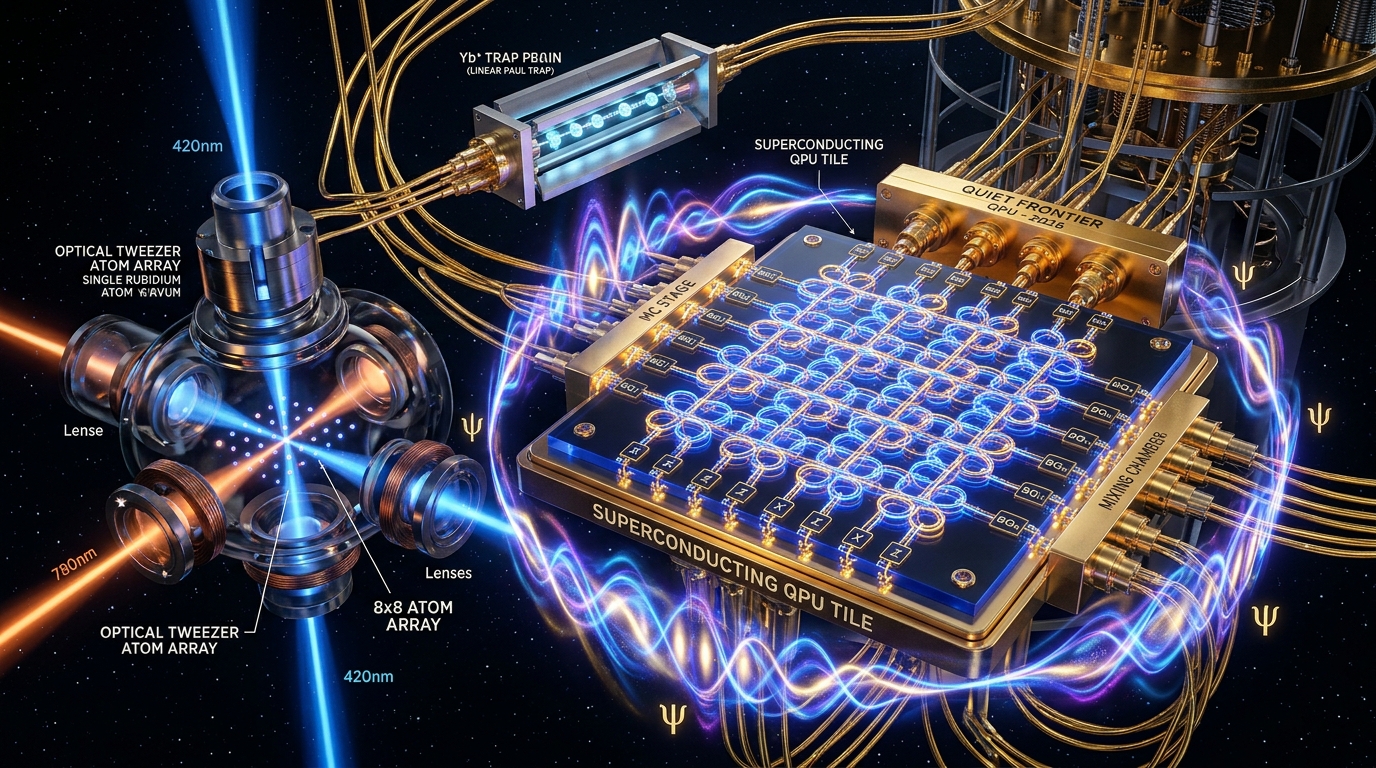
What Was Demonstrated: Neutral-atom tweezer arrays scale readily to thousands of atomic qubits in free space, but connecting modular processors requires photon-mediated interconnects. Standard free-space high-NA objective lenses suffer from low photon collection efficiencies, restricting remote entanglement rates to ~200 Hz per atom.
By integrating optical tweezer arrays with high-cooperativity nanophotonic crystal cavities and Fabry-Perot microcavities, researchers demonstrated enhanced atom-photon coupling, enabling remote entanglement generation rates exceeding . This matches the timescales of local two-qubit Rydberg gates, creating a viable blueprint for modular, multi-zone neutral-atom processors.
Significance & Limitations: Resolves the photon extraction bottleneck for distributed quantum computing. However, cavity alignment stability, thermal expansion, and mechanical vibration in ultra-high vacuum systems present demanding engineering hurdles before commercial deployment.
Comprehensive Modality Comparison (Late 2026)
| Modality | Primary Proponents | Q3–Q4 2026 Landmark | Physical Strengths | Core Unsolved Bottleneck |
|---|---|---|---|---|
| Superconducting Circuits | Google, IBM, Zhejiang Univ., Silicofeller | Distance-7 surface code state teleportation transition; directed execution runtimes. | Fast gate speeds (~20 ns), mature lithography and microwave EDA tools. | Dielectric two-level system (TLS) losses, microwave line heat load at 15 mK. |
| Trapped Ions | Quantinuum, IonQ, USTC | Autonomous QEC beating break-even (~11.6 ms); 99.9995% logical memory fidelity. | Identical atomic qubits, long coherence times, all-to-all connectivity. | Slow gate speeds (~10–100 μs), complex shuttling logistics in large QCCD traps. |
| Neutral Atoms | QuEra, Harvard, Pasqal | High-cooperativity cavity QED interconnects; reconfigurable tweezer shuffling. | Scalable to >1,000 atoms in free space, native 3D geometry reconfigurability. | Background gas atom loss, optical power dissipation, Rydberg state decay. |
| Bosonic Cavities | Yale, Univ. of Chicago, Alice & Bob | Error-semitransparent universal control with 5× infidelity drop. | Hardware efficiency (1 cavity = 1 logical qubit), single-photon loss dominance. | Transmon ancilla non-linearity introduces uncorrectable phase-flip channels. |
3. Quantum Facts You Might Not Know
Beyond press releases and high-level milestones, quantum hardware engineering involves fascinating, counter-intuitive physics that directly shapes processor architecture:
1. 180× Colder Than Deep Space
The mixing chamber of a dilution refrigerator operates at approximately 10 to 15 millikelvin. Interstellar deep space, warmed by the cosmic microwave background, sits at 2.7 Kelvin. A transmon processor is thus roughly 180 times colder than the vacuum of space. This extreme refrigeration is thermodynamically mandatory: thermal energy () must remain orders of magnitude lower than the microwave transition energy () to prevent thermal photon excitations from destroying the ground state.
2. Zero-Dissipation Non-Linearity
Linear LC resonators produce an evenly spaced harmonic ladder of energy states, meaning driving the transition also excites higher energy states (), making qubit isolation impossible. The Josephson junction is the only known electronic component that provides non-linear inductance without introducing electrical resistance and dissipation, compressing higher energy transitions and isolating a true computational two-level system.
3. Cosmic Ray Muon Quasiparticle Poisoning
Superconducting quantum chips are vulnerable to environmental ionizing radiation. When a cosmic ray muon strikes the silicon or sapphire substrate, it deposits mega-electronvolt energy bursts that emit high-energy acoustic phonons. These phonons travel across the chip and rupture Cooper pairs into non-equilibrium quasiparticles, causing simultaneous, correlated error bursts across dozens of physical qubits simultaneously. Leading foundries are now etching acoustic phonon-trapping trenches into chip substrates to mitigate this effect.
4. The "Surface Code Magic State Tax"
Under the Eastin-Knill theorem, no quantum error-correcting code can implement a universal set of logical gates transversally (using only bitwise physical operations). In 2D surface codes, non-Clifford gates (such as the -gate) require magic state distillation. In a fault-tolerant processor, up to 90% of all physical qubits may be dedicated entirely to distillation factories that produce clean magic states, which is why 2026's architectural advances in qLDPC bivariate bicycle codes and autonomous QEC are economically transformative.
4. Realistic Implications for Quantum Chip Design & EDA
What do these scientific achievements mean for the researchers, students, and hardware engineers designing physical quantum processors?
The era of manually drawing transmons in Python scripts or AutoCAD is over. As systems scale from 10 to hundreds of physical qubits, chip performance is governed by physical integration bottlenecks:
- Frequency Allocation & Collision Avoidance: Each transmon requires a defined operating frequency (typically 4–6 GHz) detuned from its neighbors to prevent unwanted -crosstalk and stray swap interactions. Squeezing hundreds of qubits into a finite microwave spectrum while avoiding two-level system (TLS) dielectric defect crossings demands automated graph-coloring frequency planning algorithms.
- Capacitive & Inductive Coupling Precision: Coupler buses must achieve exact exchange coupling rates (). Deviations of even 2 fF in mutual capacitance can degrade gate fidelity below the fault-tolerant threshold.
- Design-Rule Checking (DRC) for Cryogenic Lithography: Ground planes require patterned flux-trapping holes (slots) to pin stray magnetic vortices that cause microwave dissipation. Traces must obey minimum bend radii to prevent local electromagnetic field concentrations.
- Scalable Control & Readout Multiplexing: Routing independent microwave coaxial lines to every qubit creates an unsustainable cryogenic thermal heat load at 15 mK. Hardware engineers must design frequency-multiplexed readout feedlines capable of interrogating dozens of resonators on a single line.
Synthesize Advanced Superconducting Chips on Silicofeller
Whether you are planning transmon frequency grids to eliminate crosstalk or synthesizing coplanar waveguide feedlines with verified DRC, Silicofeller provides a physics-grounded, web-native EDA platform with automated Qiskit Metal export.
Frequently Asked Questions
1. Does having more physical qubits guarantee a more powerful quantum computer?
No. Increasing the number of physical qubits without maintaining two-qubit gate fidelities well above the fault-tolerance threshold simply compounds physical errors and crosstalk. A 100-qubit processor with 99.9% gate fidelity capable of error-corrected logical encoding is vastly more computationally capable than a 1,000-qubit processor with 98% fidelity.
2. What does "beating the break-even point" signify in quantum error correction?
The break-even point is crossed when the coherence lifetime of a protected logical qubit exceeds the lifetime of the best uncorrected physical constituent in the system. Because error correction introduces auxiliary ancillas and operations that can themselves fail, beating break-even proves that the error-correction mechanism provides a net positive physical benefit.
3. How do Autonomous QEC protocols differ from active syndrome measurement?
Active QEC measures physical error syndromes at discrete time intervals, transmits the bitstrings to an FPGA decoder, and applies corrective microwave pulses. Autonomous QEC (AQEC) relies on engineered physical dissipation (e.g., continuous sympathetic cooling or reservoir engineering) to continuously pump entropy out of the system without requiring discrete measurements or latency-limited classical feedback loops.
4. When will fault-tolerant quantum computers break RSA-2048 encryption?
Factoring 2048-bit RSA integers via Shor's algorithm requires approximately 2,000 to 4,000 high-fidelity logical qubits executing several billion modular multiplication operations. Given current progress in qLDPC architectures and cryogenic interconnects, expert consensus places this capability between 2033 and 2038. However, due to "harvest-now, decrypt-later" adversarial risks, post-quantum cryptographic migration is an immediate mandate.
5. Which quantum computing hardware modality is currently in the lead?
The field has differentiated by operational strengths rather than a single winner. Superconducting circuits dominate in fast gate speeds (~20 ns) and mature planar microwave EDA tools. Trapped ions excel in raw single- and two-qubit gate fidelities and all-to-all connectivity. Neutral atoms offer rapid scaling to thousands of optical traps in free space. Bosonic systems deliver superior hardware efficiency per logical qubit.