Executive Summary
The Model Context Protocol (MCP) is an open standard that replaces fragmented, brittle glue scripts with a universal JSON-RPC 2.0 interface connecting foundation models to external engineering tools, electromagnetic solvers, and lab instrumentation. This article explores how MCP bridges AI assistants with superconducting qubit layout engines, automated design-rule checking (DRC), and Hamiltonian parameter extraction. We examine the transformative 2026-07-28 stateless protocol release, distinguish specifications from SDK implementations, and detail the strict human-in-the-loop safeguards and authorization boundaries essential when AI systems interact with cryogenic hardware.
Key Takeaways
- Open Standard over Monoliths: MCP standardizes communication into Hosts, Clients, and Servers, replacing brittle custom integrations with a scalable architecture.
- The 2026-07-28 Spec Overhaul: The protocol transitioned to a stateless architecture—eliminating session handshakes and sticky headers, introducing Multi Round-Trip Requests (MRTR) for interactive inputs, adding cache controls, and decoupling Tasks into formal extensions.
- Specification vs. SDK vs. Server: The protocol defines the wire format and message schemas; SDKs (such as Python
mcpv2.3.0 and TypeScript@modelcontextprotocol/sdk) provide runtime bindings; and individual servers implement domain logic. - Standardization ≠ Correctness: MCP standardizes how tools and context are exposed; it does not make foundation models reliable, guarantee scientific validity, or grant automatic physical access to dilution refrigerators.
- Mandatory Human Safety Gates: Consequential actions—such as dispatching computationally intensive 3D Maxwell simulations or microwave drive pulses—demand explicit human-in-the-loop approvals, least-privilege token scopes, and input/output sanitization.
- Verified Engineering Status: Silicofeller currently implements an internal prototype MCP server with 17 deterministic tools and local tokens (
sfmcp_...), while cloud-hosted multi-tenant infrastructure and automated cryogenic execution remain on the future research roadmap.
1. The Integration Crisis in Quantum EDA
Designing a functional superconducting quantum processor is among the most demanding multidisciplinary endeavors in modern engineering. A quantum hardware engineer does not merely route planar electrical interconnects; they balance non-linear Josephson junction physics, solve 3D Maxwell electromagnetic field distributions, route impedance-matched coplanar waveguides (CPWs), minimize dielectric two-level system (TLS) losses, and calibrate gigahertz microwave control lines operating at 15 millikelvin [1].
Historically, the toolchain supporting this workflow has been deeply fragmented across siloed software ecosystems:
- Layout & CAD Engines: Python frameworks like Qiskit Metal or GDSPY to position qubit pads, readout resonators, and flux bias lines.
- Electromagnetic Solvers: Full-wave finite element solvers (such as Ansys HFSS or Q3D Extractor) to compute capacitance matrices, cross-coupling coefficients, and quality factors ().
- Quantum Hamiltonian Solvers: Analytical packages like pyEPR, scqubits, and QuTiP to diagonalize circuit Hamiltonians, extract Kerr non-linearities, and compute dispersive shifts () and exchange couplings ().
- Cryogenic Instrumentation: Proprietary Arbitrary Waveform Generator (AWG) control software synthesizing microwave drive pulses for dilution refrigerator execution.
Connecting these disparate tools has historically demanded thousands of lines of fragile, custom Python glue code. When researchers began leveraging large language models (LLMs) to automate chip layout and parameter exploration, this fragmentation worsened: every lab created bespoke, non-standardized tool-calling wrappers. The Model Context Protocol (MCP) directly resolves this integration crisis by providing a universal, open standard for AI-assisted computational engineering [2].
2. Architecture Overview: Hosts, Clients, Servers, and Primitives
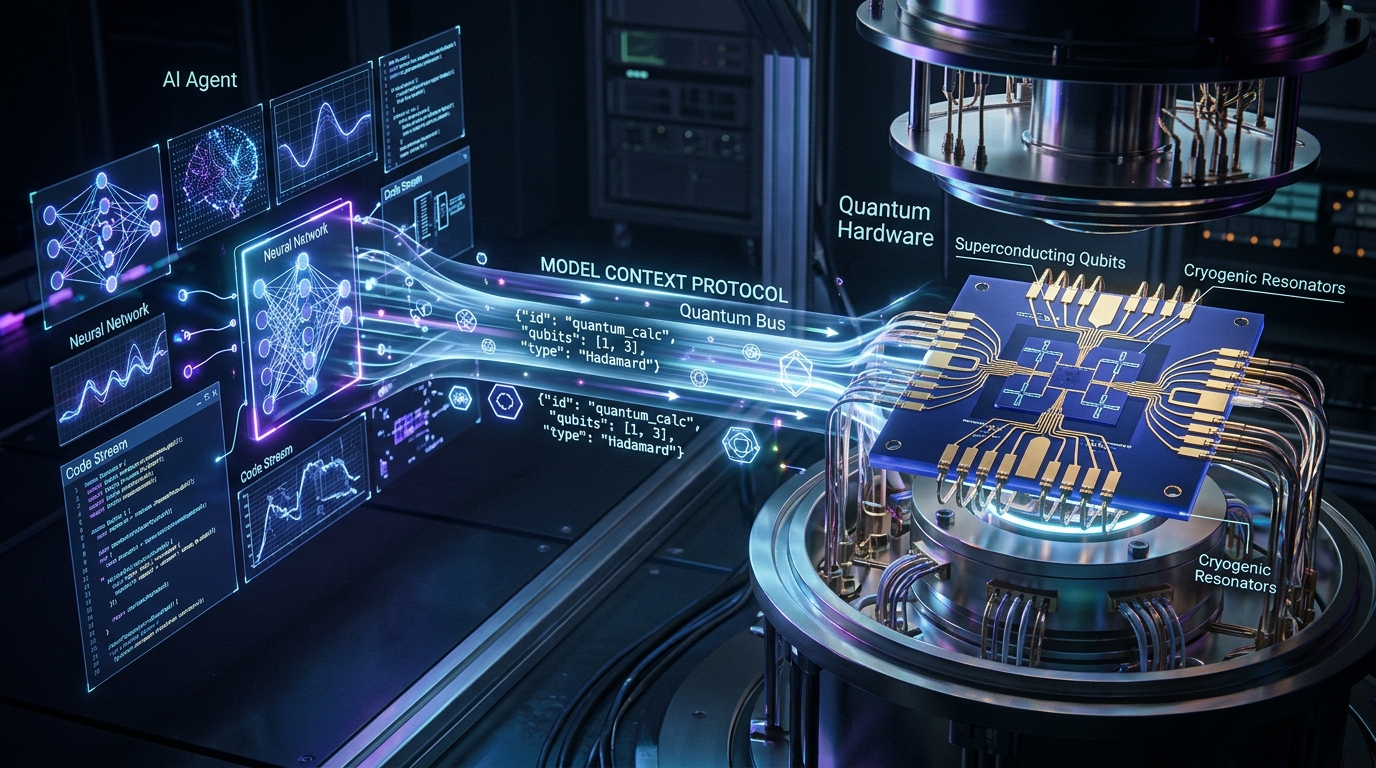
Released as an open standard by Anthropic in November 2024 and maintained by the Model Context Protocol Working Group, MCP acts as a universal communication protocol—often analogized as the "USB-C port for AI applications" [3]. Built on JSON-RPC 2.0, MCP decouples the host AI interface from the underlying domain tools.
The Three Core Architectural Roles
MCP defines three distinct architectural roles governing how data, execution requests, and security boundaries flow across the stack [4]:
| Role | Protocol Definition | Quantum Engineering Manifestation |
|---|---|---|
| Host | The user-facing runtime environment and cognitive orchestrator running the foundation model. | Claude Desktop, Claude Code terminal CLI, or Silicofeller Quantum Studio IDE. |
| Client | The embedded protocol adapter inside the Host that manages message lifecycles, capability negotiation, and transport connections. | Internal MCP connector handling JSON-RPC parsing, user-consent confirmation dialogues, and retry policies. |
| Server | The domain service exposing contextual primitives (Tools, Resources, Prompts) via standardized interfaces. | Silicofeller MCP server, local SQuADDS dataset service, or Ansys HFSS analytical worker process. |
The Three Primitives: Tools, Resources, and Prompts
- Tools (Executable Functions): Model-invocable operations that mutate state or run heavy computations (e.g., placing transmon pads, routing CPW feedlines, running DRC geometry checks, extracting Hamiltonian parameters). Tools declare strict JSON Schema input/output specifications [5].
- Resources (Declarative Read-Only Context): Uniform Resource Identifier (URI)-addressed data streams providing contextual grounding without side effects (e.g., component catalogs at
quantum://catalog/components, dilution refrigerator stage telemetry atquantum://telemetry/fridge/mixing_chamber, or project netlists) [6]. - Prompts (Guided Workflow Templates): Server-defined prompting templates exposed to engineers in the Host UI, such as parameterized workflows for frequency collision planning or Bell-state resonator sizing.
3. The 2026-07-28 Specification Release: What Changed for Real Engineering Agents
On July 28, 2026, the Model Context Protocol Working Group published an official major specification revision that fundamentally transformed MCP from a primarily local, session-bound protocol into an enterprise-ready, horizontally scalable standard [2]. For engineering platforms like Silicofeller, these changes directly resolved critical bottlenecks in multi-tenant reliability and long-running simulation dispatch:
1. Stateless Protocol Architecture & Session Elimination
In earlier iterations of MCP, remote connections over HTTP relied on an explicit bidirectional handshake (initialize followed by initialized) and a stateful Mcp-Session-Id header. If a network blip occurred or an intermediate load balancer routed a subsequent request to a different container, the session was severed.
The 2026-07-28 specification eliminated protocol-level handshakes and session pinning for remote deployments. MCP is now a stateless request/response protocol over HTTP:
- Every request explicitly declares its protocol version, client identity, and capability flags inside a dedicated
_metapayload and via theMCP-Protocol-VersionHTTP header. - Servers can be load-balanced using standard round-robin or serverless edge infrastructure (e.g., Cloudflare Workers) with zero sticky-session synchronization.
- Server capability discovery is achieved via an idempotent
server/discoverendpoint rather than blocking connection handshakes.
2. Multi Round-Trip Requests (MRTR)
Previously, if an MCP server needed clarification, user confirmation, or dynamic input during tool execution, it relied on server-initiated reverse streams (such as sampling or elicitation). In web-scale remote environments, reverse streams frequently failed due to corporate firewalls, NAT routers, and API gateway timeouts.
The 2026-07-28 release introduced Multi Round-Trip Requests (MRTR):
- When a tool requires human approval or an engineer's input (e.g., approving a 10-minute 3D finite element simulation sweep), the server responds immediately with an
input_requiredstatus code and a descriptive input schema. - The client prompts the engineer, collects the response, and re-issues the original request augmented with the user's explicit authorization and parameters.
- This preserves full protocol statelessness while providing a deterministic, auditable human-in-the-loop approval gate.
3. Tool Caching Controls (ttlMs & cacheScope)
Querying large tool catalogs (tools/list) on every turn introduced unnecessary latency. The new specification introduced cache control hints (ttlMs in milliseconds and cacheScope), allowing clients to safely cache verified EDA tool schemas while ensuring prompt invalidation when underlying project models update.
4. Modular Extensions & Deprecation Timeline
Long-running asynchronous background jobs (such as finite-element electromagnetic sweeps) and server-rendered interactive UI widgets (MCP Apps) were moved out of the core protocol and into formal, decoupled extensions. Concurrently, legacy primitives (Roots, Sampling, and Logging) entered a structured deprecation cycle under a formal 12-month transition window.
4. Clarifying the Stack: Specification vs. SDK vs. Server
A common source of confusion in AI engineering is conflating the wire specification with client software libraries and concrete backend servers. Maintaining this distinction is essential for technical accuracy:
| Layer | What It Is | Current Official Status (October 2026) | Concrete Role in Quantum Workflows |
|---|---|---|---|
| Protocol Specification | The normative, language-agnostic standard defining JSON-RPC 2.0 schemas, HTTP headers, error codes, and stateless lifecycle rules. | 2026-07-28 Specification published at modelcontextprotocol.io. | Guarantees that any compliant client (Claude, Cursor, custom IDEs) can interact seamlessly with any compliant quantum server. |
| SDK Implementation | Official programming language libraries providing message serialization, transport drivers, error mapping, and type-safe server/client harnesses. | Python: mcp v2.3.0 (stable on PyPI) [7].TypeScript: @modelcontextprotocol/sdk v1.x (with scoped v2 packages @modelcontextprotocol/server and @modelcontextprotocol/client) [8]. | Provides the software foundation used by backend developers to build tools without writing raw JSON-RPC sockets. |
| Individual MCP Server | An application-specific domain service that exposes concrete tools, resources, and business logic over an MCP transport. | Silicofeller MCP Server (developer prototype in mcp_server/ with 17 registered tools). | Translates AI requests into deterministic REST calls against the Silicofeller CAD canvas, Qiskit Metal codegen, and frequency planning algorithms. |
5. Illustrative Example: AI-Assisted Circuit Synthesis & Hamiltonian Extraction
To understand how an AI assistant interacts with quantum software through MCP, consider a practical engineering task: an engineer asks Claude Desktop to connect two transmon qubits with a capacitive coupling bus, run design-rule checking (DRC), and extract the expected Hamiltonian coupling strength ().
User Prompt in Host (Claude):
"In Silicofeller project Bell_Pair_01, route a capacitive coplanar waveguide coupler between Q0 (bus pin) and Q1 (bus pin) with a 10 μm trace width and 6 μm gap. Verify zero DRC clearance violations and extract the expected exchange coupling rate g."
Step 1: The MCP Tool Call Request (Client → Server)
The model reasons over available schemas and emits a structured JSON-RPC 2.0 tool invocation adhering to the 2026-07-28 stateless format:
{
  "jsonrpc": "2.0",
  "id": "req-sf-8902",
  "method": "tools/call",
  "params": {
    "name": "connect_pins",
    "arguments": {
      "project_id": "proj_bell_pair_01",
      "source_pin": "Q0:bus",
      "target_pin": "Q1:bus",
      "route_type": "RouteMeander",
      "trace_width_um": 10.0,
      "trace_gap_um": 6.0,
      "fillet_radius_um": 50.0,
      "verify_drc": true
    },
    "_meta": {
      "protocolVersion": "2026-07-28",
      "clientId": "claude-desktop-client-v2.1",
      "traceparent": "00-4bf92f3577b34da6a3ce929d0e0e4736-00f067aa0ba902b7-01"
    }
  }
}
Step 2: Server Execution, DRC Validation, and Physics Grounding
The server validates authorization via the scoped bearer token, invokes the deterministic geometry engine, executes collision-avoiding meander routing, checks ground-plane clearances, and computes analytical capacitance values:
{
  "jsonrpc": "2.0",
  "id": "req-sf-8902",
  "result": {
    "status": "success",
    "route_id": "route_coupler_q0_q1",
    "route_length_um": 2140.5,
    "drc_evaluation": {
      "status": "PASS",
      "clearance_violations": 0,
      "minimum_gap_observed_um": 6.0
    },
    "extracted_parameters": {
      "mutual_capacitance_fF": 4.18,
      "qubit_0_frequency_GHz": 5.12,
      "qubit_1_frequency_GHz": 4.95,
      "coupling_strength_g_over_2pi_MHz": 72.4,
      "dispersive_shift_chi_over_2pi_MHz": -1.48
    },
    "editor_link": "https://silicofeller.com/editor/proj_bell_pair_01?focus=route_coupler_q0_q1"
  }
}
Step 3: AI Assistant Interpretation
Rather than fabricating or guessing numerical values, the AI assistant synthesizes the exact data returned by the deterministic server:
"I have routed the coplanar waveguide coupler between Q0 and Q1. The route length is 2,140.5 μm with a 50 μm fillet radius, successfully passing all design-rule checks with zero ground-plane clearance violations. Capacitance extraction yields a mutual coupling capacitance of , corresponding to an exchange coupling rate of and a dispersive shift of . You can review and edit the generated geometry in the Silicofeller Schematic Editor."
Rigorous Component Status Verification
In technical content strategy, distinguishing active production software from conceptual roadmap features is paramount. Every element in the workflow above is categorized as follows:
| Workflow Component | Status Category | Technical Verification Details |
|---|---|---|
17 Deterministic MCP Tools (add_components, connect_pins, etc.) | [Implemented & Verified] | Fully functional in Silicofeller developer prototype (mcp_server/silicofeller_mcp/server.py); verified end-to-end against local SQLite and FastAPI backends. |
Personal MCP Scoped Tokens (sfmcp_...) | [Implemented & Verified] | 90-day revocable personal tokens validated via SHA-256 hash checks with password-invalidation cascades. |
| Qiskit Metal Python Codegen | [Implemented & Verified] | Backend endpoint compiles saved schematic coordinates into valid Qiskit Metal script definitions. |
| Cloud Multi-Tenant Hosted MCP Server | [Proposed / Under Development] | Docker/compose deployment config created; cloud production deployment and live Redis collab bus synchronization are planned next steps. |
| Full-Wave 3D FEM Simulation Sweeps (Ansys HFSS) | [Proposed / Planned] | Analytical capacitance approximations are implemented; automated dispatch of multi-hour distributed 3D Maxwell sweeps via MCP is proposed. |
| Autonomous Cryogenic AWG Pulse Tuning | [Hypothetical / Active Research] | Active research across academic physics labs; direct closed-loop AI control of dilution refrigerator microwave lines requires physical safety interlocks. |
| Autonomous Mask Tapeout to Cleanroom | [Hypothetical / Future Concept] | Human cleanroom review and physical wafer sign-off remain mandatory prior to electron-beam lithography mask fabrication. |
6. Security, Governance, and Human Safety: Why Physics Demands a Barrier
A fundamental tenet of AI safety in engineering is that MCP standardizes how applications expose tools and context; it does not automatically make an AI reliable, grant hardware access, or guarantee scientific correctness.
In software engineering, a hallucinated syntax error merely produces a failed compile. In quantum hardware engineering, an unconstrained or hallucinated command can cause physical destruction:
- Thermal Quenching: Excessive microwave drive power dispatched to a dilution refrigerator can overwhelm its 15 mK cooling power (~10–20 μW), warming the mixing chamber and quenching superconducting solenoid magnets.
- Josephson Junction Burnout: Sub-micron aluminum-oxide tunnel junctions possess critical currents () on the order of 10 to 50 nanoamperes. Exceeding breakdown voltages permanently destroys the qubit.
- Cost Overruns: Unchecked agentic loops initiating unconstrained 3D eigenmode adaptive mesh passes in Ansys HFSS can exhaust thousands of cloud High-Performance Computing (HPC) credits within hours.
The Defense-in-Depth Security Framework
To mitigate these risks, production-grade quantum MCP integrations enforce rigorous enterprise security controls [9]:
- OAuth 2.1 with PKCE & RFC 8414 Discovery: Remote connectors negotiate authentication via Proof Key for Code Exchange without exposing user passwords or static credentials in model prompts.
- Strict Principle of Least Privilege: Scopes are granularly partitioned. An AI assistant assisting with schematic drafting is restricted to
design:readanddrc:runscopes, while write access to fabrication files (gds:export) or physical hardware is denied by default. - Input & Output Sanitization: All tool inputs are strictly validated against JSON Schemas before reaching domain solvers. Output data returned to the model is sanitized to prevent prompt injection or indirect command execution via untrusted third-party tool responses.
- No Secrets in URIs or Logs: In compliance with security specifications, tokens and API keys are strictly delivered in the
Authorization: Bearerheader, never in query parameters where they could be logged by proxy servers. - Auditing & Rate Limiting: Immutable audit logs track every tool invocation, arguments, and client ID, accompanied by per-user rate limiters (e.g., 60 calls/minute) to suppress runaway agentic loops.
- Interactive Human Approval for Consequential Actions: Under the 2026-07-28 MRTR specification, high-consequence operations (triggering high-compute simulations, deleting projects, or dispatching microwave pulses) automatically trigger an
input_requiredgate demanding explicit human confirmation in the Host UI before execution.
7. A Realistic Future Workflow: The Engineer-in-the-Loop Quantum Co-Pilot
Rather than replacing quantum engineers, the convergence of MCP and foundation models enables an accelerated, physics-grounded co-design workflow:
- Specification & Intent: The engineer specifies target qubit parameters (e.g., transmon charging energy , Josephson energy , and target transition frequency ).
- AI Architectural Proposal: The AI queries the component catalog via an MCP resource (
quantum://catalog/components), selects appropriate capacitor pad dimensions, and drafts a layout. - Deterministic DRC Gate: The MCP server automatically executes local design-rule checks, verifying trace widths, ground-plane slotting to suppress vortex pinning, and minimum 15 μm pad clearances.
- Simulation Approval Gate: Before dispatching an electromagnetic capacitance extraction, the MCP server returns an
input_requiredconfirmation detailing estimated compute time and credit cost. The engineer clicks "Approve" in their IDE. - Parameter Review & Decision: The returned Hamiltonian parameters () are synthesized and displayed on the interactive schematic canvas. The engineer verifies that the cross-Kerr coupling is sufficiently detuned to avoid two-level system (TLS) defect crossings before committing the layout.
Explore AI-Assisted Quantum Design in Silicofeller
Discover how Silicofeller Quantum Studio combines interactive schematic capture, automated design-rule checks (DRC), and deterministic tool integration to accelerate superconducting circuit design.
Frequently Asked Questions
1. What is the fundamental difference between MCP and a traditional REST API?
A REST API requires bespoke, hardcoded client wrappers and manually maintained endpoints for every connecting application. MCP standardizes tool schemas, contextual resources, and prompt templates over JSON-RPC 2.0 with dynamic capability discovery, allowing any compliant AI host (e.g., Claude Desktop, Claude Code, or IDE extensions) to discover and invoke tools without custom adapters.
2. Does connecting an AI assistant to Silicofeller via MCP send proprietary chip geometries to model providers?
No. Only the specific parameters required for semantic reasoning (e.g., component names, terminal coordinates, and high-level DRC rule outcomes) are passed within the tool call message payload. Proprietary full-wave 3D electromagnetic meshes, wafer mask databases, and underlying GDSII files remain protected within the local or private server environment.
3. How did the 2026-07-28 MCP specification change how servers handle long-running simulations?
The 2026-07-28 specification eliminated stateful session pinning and reverse server push streams, replacing them with Multi Round-Trip Requests (MRTR) and decoupled Task extensions. For intensive operations, servers immediately return an initial job reference or an input_required code, allowing the host to poll or await completion without blocking interactive dialogues or risking severed network streams.
4. Can an MCP server execute entirely offline in air-gapped laboratory environments?
Yes. The MCP specification natively supports the stdio transport layer, where the host executes the server as a local child process. Messages pass strictly through standard input and output streams without network sockets, enabling completely offline execution suitable for secure quantum laboratory cleanrooms and defense installations.
5. Does Silicofeller's current MCP integration allow Claude to directly program a physical quantum processor?
No. Silicofeller's verified MCP prototype focuses strictly on design automation: placing schematic components, checking DRC clearances, planning frequencies, and generating Qiskit Metal code. Direct closed-loop dispatch to cryogenic physical processors remains an active academic research frontier requiring certified hardware interlocks.